
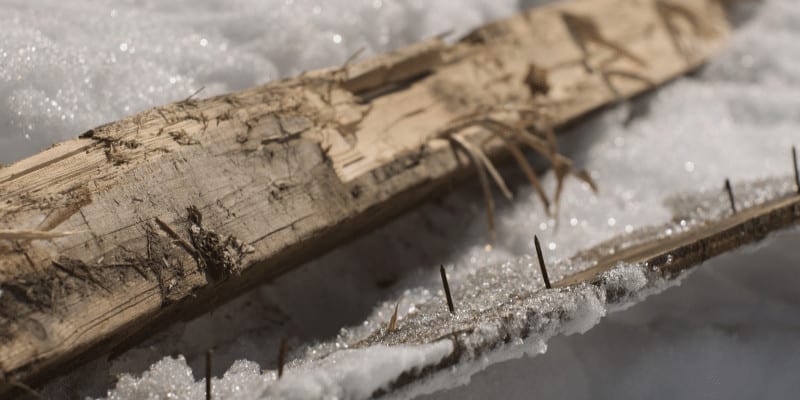
Wood with nails may be valuable lumber, ordinary project debris, or treated material that needs special handling. Check its history and condition before pulling nails or choosing a disposal route.
Keep exposed nails away from walkways and collection crews. Your hauler or reuse center should tell you how it wants the wood prepared.
Check Whether the Wood Can Be Reused
Sound boards, hardwood flooring, beams, trim, fencing, and other clean lumber may interest a reuse center, builder, artist, or neighbor.
EPA lists lumber among the materials commonly handled by building-material reuse centers. Acceptance depends on dimensions, condition, treatment, coatings, and the recipient’s needs.
Do not hide nails, rot, stains, odors, insect damage, or an uncertain material history. Those details affect whether someone can use the wood safely.
Copy This Salvage Listing
Wood available: [quantity] pieces, about [dimensions]. Nails are [removed / bent flat / still present]. Coating or treatment is [known details / unknown].
Condition: [sound / weathered / damaged]. Pickup requires [vehicle or lifting note]. Please confirm that this material suits your project.
Look for Treatment, Paint, and Contamination
Pressure-treated wood may have an end tag, stamp, surface incisions, or a greenish or brown tint. Appearance alone cannot identify every treatment.
Wood from an older structure may also carry lead-based paint or other contaminants. Do not sand or strip an unknown coating simply to make the board look recyclable.
If the board held chemicals, came from a contaminated site, or has an unknown industrial use, describe that history to your local waste program.
Do Not Burn Treated, Painted, or Unknown Wood
Washington State’s household guidance says never burn, compost, or mulch treated wood. EPA likewise warns against open burning CCA-treated wood.
Do not turn treated, painted, glued, stained, or uncertain wood into firewood, cooking fuel, mulch, sawdust, or garden fill.
Even clean wood burning can be restricted by local air-quality rules or temporary burn bans. Disposal is not a reason to start a backyard fire.
Deal With the Nails Carefully
Ask the receiving facility whether nails must come out. Many reuse recipients prefer denailed boards, while some construction-waste processors accept wood with fasteners.
If you can remove a nail with ordinary hand tools, wear eye protection and gloves suited to the work. Support the board on a stable surface.
Do not grind, shred, or aggressively sand uncertain treated or painted wood. Leave difficult fasteners in place and warn the recipient or facility.
When a nail cannot be removed, ask whether the facility wants it bent flat, covered, separated, or left visible. Follow its answer instead of improvising a cover.
Choose a Local Disposal Route
Curbside size, weight, bundling, and nail rules vary by hauler. Do not assume a two-foot by four-foot bundle is accepted where you live.
Search your city or county directory for “lumber,” “construction debris,” “treated wood,” and “bulky waste.” Call before leaving wood at the curb.
Tell the program whether the waste came from your household or a paid contractor. Some programs separate resident-generated debris from business or contractor waste.
For treated wood, ask which permitted landfill, transfer station, or special facility accepts it. Washington’s household route is one local example and does not apply nationwide.
I have [quantity and size] of wood with [nails present or removed]. It is [untreated / treated / painted / unknown]. Do you accept it, and how should I prepare it?